 I'm pleased to be reminded of the album again, which served as my introduction to Bowie's pre-RCA years. It was soon supplanted by more comprehensive compilations such the 1972 double-album Images 1966 - 1967 and the 1981 compilation Another Face, which included two Davie Jones numbers Liza Jane and Louie, Louie Go Home but I remain very fond of the World of David Bowie nonetheless. My copy of the album is not the original 1970 edition but 1973 re-press which updated Bowie's 1969 curls to a very 1972-era Ziggy mullet for the sleeve shot, and I'm currently listening to the album, after a fashion, courtesy of the Deram Anthology 1966-1968 CD, programmed to follow The World of David Bowie track listing. Incidentally, the 1973 Dutch re-press which also features the Ziggy cover subtly replaces the fabulous When I Live My Dream with the not so fabulous Laughing Gnome !
Showing posts with label David Bowie. Show all posts
Showing posts with label David Bowie. Show all posts
Thursday, 6 May 2021
The World of David Bowie
I've just finished reading Daryl Easlea's lead feature on David Bowie's 1970's masterpiece The Man Who Sold The World in the May 2021 issue of Record Collector. The circumstances that led to the recording of the album and the inherent mythology that surrounds it - the album's proto-heavy metal licks, the arrival of Mick Ronson, the eerie sci-fi Moog textures, the dress and cowboy covers, the influence of Terry Burns, have all been documented elsewhere in forensic detail, but Easlea's article is superb nonetheless at capturing what was an incredibly exciting time in Bowie's life and music. Seemingly a world away from the songs Bowie had written for the album is the Decca compilation The World of David Bowie which is included in a sidebar of the article - the connection being that the Decca album was the only Bowie record issued in the UK in 1970 - The Man Who Sold the World was still 11 months away, finally arriving in April 1971. Interestingly, Decca's World of... series was more than a vault-emptying exercise, the label's intention was to give curious listeners an affordable introduction to an artist, and the series, if the Discogs listing can be trusted, lasted well in to the 80's. Bowie was pleased that he was joining the likes of Mantovani and Val Doonican on the World of... series, and Bowie himself selected the songs for the album - 10 tracks from his 1967 debut David Bowie plus a few essential odds and sods - The London Boys, Karma Man, Let Me Sleep Beside You and In the Heat of the Morning.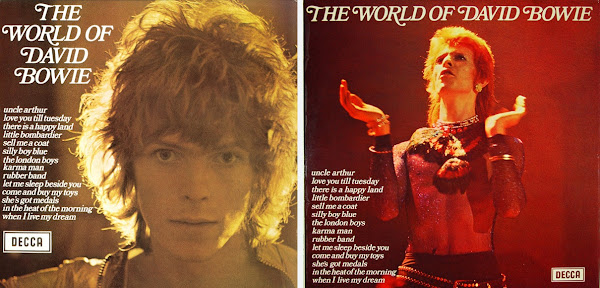 I'm pleased to be reminded of the album again, which served as my introduction to Bowie's pre-RCA years. It was soon supplanted by more comprehensive compilations such the 1972 double-album Images 1966 - 1967 and the 1981 compilation Another Face, which included two Davie Jones numbers Liza Jane and Louie, Louie Go Home but I remain very fond of the World of David Bowie nonetheless. My copy of the album is not the original 1970 edition but 1973 re-press which updated Bowie's 1969 curls to a very 1972-era Ziggy mullet for the sleeve shot, and I'm currently listening to the album, after a fashion, courtesy of the Deram Anthology 1966-1968 CD, programmed to follow The World of David Bowie track listing. Incidentally, the 1973 Dutch re-press which also features the Ziggy cover subtly replaces the fabulous When I Live My Dream with the not so fabulous Laughing Gnome !
I'm pleased to be reminded of the album again, which served as my introduction to Bowie's pre-RCA years. It was soon supplanted by more comprehensive compilations such the 1972 double-album Images 1966 - 1967 and the 1981 compilation Another Face, which included two Davie Jones numbers Liza Jane and Louie, Louie Go Home but I remain very fond of the World of David Bowie nonetheless. My copy of the album is not the original 1970 edition but 1973 re-press which updated Bowie's 1969 curls to a very 1972-era Ziggy mullet for the sleeve shot, and I'm currently listening to the album, after a fashion, courtesy of the Deram Anthology 1966-1968 CD, programmed to follow The World of David Bowie track listing. Incidentally, the 1973 Dutch re-press which also features the Ziggy cover subtly replaces the fabulous When I Live My Dream with the not so fabulous Laughing Gnome !
Thursday, 19 September 2019
Dario and David
David Bowie and Dario Argento photographed for the May 1995 issue of Italian culture magazine Sette... This momentous meeting of two great icons took place in London during promotion tours for the Outside album and The Stendhal Syndrome. I don't have my 3 or 4 Bowie biographies at hand right now, but I don't recall Argento earning a mention in any of them, so I wonder will this great summit (and indeed Bowie and Argento's first meeting over in Berlin in 1978 at a dinner with Fassbinder) feature in the forthcoming English-language edition of Argento's 2014 autobiography Paura ? I was initially tempted to pre-order the book when it was first announced, but I've read a few awkwardly translated Italian reviews of the book and they suggest there's nothing terribly revelatory for seasoned Argento scholars. We'll wait and see...


Wednesday, 13 February 2019
David Bowie: Finding Fame
I just want to say that you've given me more pleasure than I've had in a good few months of working, and I don't do gigs any more because I got so pissed off with working and dying a death every time I worked and it's really nice to have somebody appreciate me for a change
David Bowie, Glastonbury, 1971
Francis Whately’s latest Bowie documentary really ought to have been called The First Five Years, following the template of the director’s previous epoch-defining films, Five Years (2013) and The Last Five Years (2017). This third installment begins in 1966 and charts the years Bowie spent drifting thru a series of throwback rock n' roll groups and mod combos in search of an audience, before settling on a peculiar style of English music hall that seemed to please no one - songs like Rubber Band, Uncle Arthur and Please Mr. Gravedigger were a tad too quaint and whimsical for the average rock fan, but too weird and avant-garde for the Anthony Newley crowd. As with the previous films, Whately wisely lets the interviewees do the talking and there are some terrific anecdotes along the way from friends and collaborators such as regulars Tony Visconti, Carlos Alomar, George Underwood, Woody Woodmansey, and Rick Wakeman, plus valuable contributions from members of The Lower Third, and The Riot Squad. Bowie himself is represented by some judicious audio extracts and his comments are often touching and surprisingly honest about his formative years.
Casual viewers who assumed Bowie came fully formed with Space Oddity, might balk at the oddities heard throughout the documentary, and perhaps to spare the blushes of seasoned fans, the song selection reflects his best work at the time - The London Boys, There Is A Happy Land, When I Live My Dream, Come and Buy My Toys, Let Me Sleep Beside You. No overview of this era could get away without mention of The Laughing Gnome and it's left to Carlos Alomar to rehabilitate this irrepressible little pest of a song, cheerfully exploring the similarities between The Laughing Gnome and The Velvet Underground's I'm Waiting for the Man. And while he's not terribly convincing, it is great fun to hear the Station to Station guitarist scatting along to what is most likely the quintessential bête noire of Bowie songs.

Some of the most interesting and compelling testimony comes from two women who were particularly close to Bowie at both ends of the 60's. Kristina Amadeus (Bowie's cousin, no less) recalls family life at the Jones home at 4 Plaistow Grove and the contrary relationship Bowie had with his parents, his mother in particular, who's frequently described by those who knew her at the time as being cold and withdrawn. Interestingly Kristina plays down the mythology that has grown up around Terry Burns, Bowie's troubled half-brother who was diagnosed with schizophrenia, a condition that served Bowie well when he re-cast Terry as a sort dark spectral presence in his life, and claimed that insanity was a hereditary family curse. Another coup for the documentary is the rare participation of Bowie's first great love Hermione Farthingale, who speaks about their year long romance with great tenderness, and reads out a letter Bowie sent her whilst touring with Lindsay Kemp's mime production Pierrot In Turquoise ("Remember that I love you, and be gooder than good, forever, David"). The couple went their separate ways when Hermione joined the cast of the MGM musical Song of Norway, sensing that Bowie's career was following a different trajectory to her own. Bowie was left broken hearted ("I didn't get over that for such a long time, it really broke me up"), but it led to Bowie writing one of his finest and most autobiographical songs, Letter to Hermione, and considering the crucial involvement of Angel Barnett in the next phase of Bowie's life, perhaps it was just as well. Some of the material showcased throughout the documentary was astonishing.
The Bowie Estate was unusually generous in supplying long lost recordings, demos and rough sketches - some of which I had only previously encountered on lo-fi boots, and the understandable absence of performance footage is made up for with a wealth of rare photographs. In one amusing aside, echoing Decca's famous rejection of The Beatles, Lower Third drummer Phil Lancaster reads the withering summation of the group's ill fated 1965 audition for the BBC penned by a clearly unimpressed talent scout. It's an incredible document. "There is no entertainment in anything they do. It's just a group and very ordinary, too, backing a singer devoid of personality". Thankfully Bowie held his nerve.

The documentary's feature length was generous but still there were a few omissions, notably the involvement of manager Ken Pitt and his attempts to revive Bowie's foundering career, which included landing Bowie some film work. Whately could hardly be criticized for skipping over Bowie's inconsequential 3-second walk on (or rather slide off) appearance in the 1969 film The Virgin Soldiers, but I thought it rather disappointing that no mention was made of Bowie's haunting turn in Michael Armstrong's interesting 1967 short The Image. Bowie later dismissed the film as "awful" but it remains Bowie's most dramatic film appearance up to The Man Who Fell To Earth.
The documentary also seemed to lurch clumsily in the final section between the recording of The Man Who Sold the World and the success of the Ziggy Stardust-era, with Hunky Dory disposed of with a quick flash of the album cover as if Whately wasn't quite sure what to do with it. And for all the scorn heaped on The Laughing Gnome, it's a pity no one made the connection between Bowie's use of the high-pitched voice for that song and the cartoon voices heard on Hunky Dory's closing song The Bewlay Brothers, arguably, Bowie's greatest song. Also, there was no mention of Peter Noone’s cover version of Oh! You Pretty Things, which didn't make its author a household name but must have offered some consolation when it climbed to a respectful 12th position in the UK charts in May 1971. I'm nip-picking of course. These minor objections do not alter the fact that Finding Fame is one of the more comprehensive Bowie documentaries to emerge since his passing and needless to say it is absolutely essential viewing. If you missed the initial BBC2 screening, the film is currently available to view on the BBC iplayer.
Friday, 26 May 2017
Not me at all
Reading an old issue of Uncut (#148, Sept 2009) over breakfast this morning and the centerpiece of the issue is an article celebrating The Beatles influence on culture in the form of 69 fascinating and sometimes fanciful factoids. I generally consider Uncut writers to a reliable bunch of scribes, but shame on the usually reliable David Cavanagh for reprinting that old howler that David Bowie recorded a cover of Penny Lane for the cut-price Music For Pleasure label in those hungry pre-fame days. I think I first read about the Penny Lane rumor in Nicholas Pegg’s excellent 2002 Complete David Bowie compendium (found in the Apocrypha section), so clearly Uncut dropped the ball on this one. I was debating on whether to post the offending cover version here - God forbid someone might skim over the post and shrug “Bowie covered Penny Lane ? That’s interesting” and propagate the myth further, but for the sake of completeness, you can listen to it here. David Cavanagh seems to have been thoroughly hoodwinked by this, writing "Note the hilarious out of time trumpet and Bowie's northern accent..." - as you will note, the vocalist, identified by Record Collector's Chris Groom as one Tony Steven, sounds nothing like the Deram-era Bowie. The Penny Lane cover first appeared on the Hits '67, one of those innocuous budget compilations that were designed squarely for the indiscriminate listener and his pitiable portable picnic player (12 Top Hits Superbly Recorded promises the front cover Can you tell the difference between these and the original sounds ?)

Incidentally, the album's entry over at Discogs includes a comment that explodes the myth, which is just as well - a seller is currently offering a copy of the album for the king's ransom of £15...


Incidentally, the album's entry over at Discogs includes a comment that explodes the myth, which is just as well - a seller is currently offering a copy of the album for the king's ransom of £15...
Monday, 22 August 2016
The Lost Bowie album
The soundtrack to The Man Who Fell to Earth will be released for the first time next month, as a double-disc CD/LP. This album will not however contain the 5 instrumental pieces Bowie composed for the film at Cherokee Studios in the fall of 1975. RCA planned to release this collection, entitled The Visitor in March 1976 to coincide with the film's UK release but Bowie withdrew his music at the 11th hour for reasons unclear. All that exists of the album is this ultra rare test-pressing.


Or perhaps not... The is my mischievous homage to Roy Carr and Charles Shaar Murray's book David Bowie: An illustrated Record, which has an entry in the discography section for the mysterious bootleg LP The Visitor containing music Bowie composed for The Man Who Fell To Earth. The album was entirely made up by the book's authors Roy Carr and Charles Shaar Murray to catch out plagiarists. I imagine Bowie collectors spent years looking for this. Here's the entry from the book.

Or perhaps not... The is my mischievous homage to Roy Carr and Charles Shaar Murray's book David Bowie: An illustrated Record, which has an entry in the discography section for the mysterious bootleg LP The Visitor containing music Bowie composed for The Man Who Fell To Earth. The album was entirely made up by the book's authors Roy Carr and Charles Shaar Murray to catch out plagiarists. I imagine Bowie collectors spent years looking for this. Here's the entry from the book.

Wednesday, 27 July 2016
Bowie RCA
The forthcoming Bowie boxset Who Can I Be Now 1974-1976 (due September) has me obsessing over album mixes again and I’m reminded of an excellent blog post which details the production of RCA’s CD series in 1984/5. Bowie’s RCA CDs are highly coveted these days, despite their 30 year vintage, the general consensus among audiophiles is that the RCA discs remain superior to the subsequent Rykodisc and EMI re-issues and best reflect the sound of the original LPs. The Steve Hoffman audiophile forums has many discussions on the merits of the RCA CDs, and while I don't indulge in the kind of obsessive compulsive nit-picking of that forum, I can say that I hated the Tony Visconti mix of the Ziggy Stardust Motion Picture album, I remember being quite appalled by the 2010 30th anniversary edition of the album, which simply sounded wrong. And the All Saints (Collected Instrumentals 1977-1999) album is marred by a particularly horrible sounding Subterraneans. The RCA CDs do not come cheap though – a NM copy of Aladdin Sane, purportedly the finest sounding of the RCA discs will cost you the equivalent of the Five Years boxset…

The majority of my Bowie CDs are the old Rykodisc issues from the early 90's, so I was curious to see what's emerged since... I see one of more recent CD re-issues of Space Oddity has had the George Underwood painting Depth of a Circle which first appeared on the original 1969 Philips album (when it was simply titled David Bowie) restored - it wasn't included in previous issues (at least it's not part of my Rykodisc CD), but it's nice to have it back in again, as it forges an interesting link between Space Oddity (the song) and Ashes to Ashes (the video). Look to the left hand side of the Underwood artwork, there is an illustration of a Pierrot type figure walking, presumably, with his mother, a la the coda of the Ashes to Ashes video...


The majority of my Bowie CDs are the old Rykodisc issues from the early 90's, so I was curious to see what's emerged since... I see one of more recent CD re-issues of Space Oddity has had the George Underwood painting Depth of a Circle which first appeared on the original 1969 Philips album (when it was simply titled David Bowie) restored - it wasn't included in previous issues (at least it's not part of my Rykodisc CD), but it's nice to have it back in again, as it forges an interesting link between Space Oddity (the song) and Ashes to Ashes (the video). Look to the left hand side of the Underwood artwork, there is an illustration of a Pierrot type figure walking, presumably, with his mother, a la the coda of the Ashes to Ashes video...

Saturday, 23 January 2016
Crystal Japan
Musings on Crystal Japan, one of David Bowie’s secret and sadly neglected masterpieces… I’ve always considered this beautiful instrumental something of an orphan, its exact lineage is still debatable. Ostensibly the track is associated with the Scary Monsters album, apparently it was intended to close the album before being relegated to the flipside of the Up the Hill Backwards single. Furthermore Rykodisc reinstated the track back into Scary Monsters when it appeared on their 1992 CD re-issue as a bonus cut. And yet, Crystal Japan, or to give it its original title Fuje Moto San, doesn’t sound much like anything recorded during Scary Monsters, in fact the piece had been written in advance of Bowie’s appearance in the Crystal Jun Rock commercial in March 1980 which puts Crystal Japan just ahead of the Scary Monsters sessions. I’m thinking the track emerged from the Lodger recordings (and if so I wonder what else missed the album’s final cut) although listening to the track this morning I think it shares some of the same DNA as Sense of Doubt off “Heroes”. Despite Crystal Japan not having any readily identifiable Japanese elements (no koto strumming like Moss Garden), I think the track with its childlike melody would sound terrific in a Studio Ghibli film. Listen here


Thursday, 14 January 2016
Bowie & Buster
Another great cinematic what-if was a planned Buster Keaton biopic starring David Bowie in the role of the Great Stone Face. Apart from a few pics of Bowie reading Rudi Blesh’s 1966 biography of Keaton during some downtime on The Man Who Fell To Earth production, I don’t think the project advanced very far but Buster was still on Bowie’s mind in 1993 when he appeared as the comic in the video for the Black Tie White Noise single Miracle Goodnight. A more substantial unrealized film project, first mooted in the early 80’s was Derek Jarman’s post-apocalyptic sci-fi film Neutron which would have featured David Bowie and Steven Berkoff as two opposing warriors of the wasteland. Ultimately the film fell through and Jarman funneled some of Neutron's ideas into his 1988 film The Last of England but in 1999, five years after Jarman’s death Bowie was still speaking enthusiastically about the project: "I want to approach his family at some time to see if we could do something with it. I have his script and his drawings. I even know down to the music how he wanted to have things done. And it would be lovely posthumously to do his piece. It would be fabulous. A wonderful script, a very scary piece of work.”

Monday, 11 January 2016
David Bowie (1947 - 2016 - ????)
A constant companion in my life thru good times and bad, thick and thin has left the stage for the last time. A rush of recent activity signaled a renewal of creativity but now I realize it was a race against time – fortunately Blackstar is a wonderful swansong and in the space of three short days the album’s meaning has changed forever. I am numb, heartbroken. I can’t think of anything profound to say. Planet Earth is blue and there's nothing I can do...

Post-script - 18th January
It has been an impossible week, and I was completely unprepared for it. I’m not a gushing sentimental type, when favorite artists leave the stage for the final time I can temper their passing knowing that they have left their mark on the world with a body of work that will last forever – I’m thinking of Peter Christopherson in 2010 and Lou Reed back in October 2013. But when I heard the news about Bowie last Monday week, I felt crushed. Blackstar had been blowing thru the house all weekend and I was looking forward to a renewal of activity and even the small hope that I might catch him this year in concert. I had no idea he had been ill – his vocals on Blackstar sound like a man in rude health – and later I was annoyed with myself for not thinking anything sinister after seeing the Lazarus video a few days previously. I don’t think I spoke to anyone on that terrible Monday, mercifully my nearest and dearest understood and left me to brood on my own. I’m still finding it difficult – reading tributes to Bowie from contemporaries and bands he inspired doesn't bring comfort, it just feels surreal – everyone talking about him in the past tense. And I haven’t listened to any Bowie music since he died - a curious side-effect of grieving I suppose. In time this will pass and the albums will be restored to their usual rotation the CD player, and I expect I will revisit the films over the next few weeks. Just last night I started re-reading Kevin Cann’s excellent encyclopedic work Any Day Now: David Bowie The London Years (1947-1974), which for now will be administered like medicine for a broken heart.
The world is now a less interesting place to live in, but I'm blessed that for a time I shared that world with David Bowie. Whoever had a better soundtrack to their life ?
Post-script - 18th January
It has been an impossible week, and I was completely unprepared for it. I’m not a gushing sentimental type, when favorite artists leave the stage for the final time I can temper their passing knowing that they have left their mark on the world with a body of work that will last forever – I’m thinking of Peter Christopherson in 2010 and Lou Reed back in October 2013. But when I heard the news about Bowie last Monday week, I felt crushed. Blackstar had been blowing thru the house all weekend and I was looking forward to a renewal of activity and even the small hope that I might catch him this year in concert. I had no idea he had been ill – his vocals on Blackstar sound like a man in rude health – and later I was annoyed with myself for not thinking anything sinister after seeing the Lazarus video a few days previously. I don’t think I spoke to anyone on that terrible Monday, mercifully my nearest and dearest understood and left me to brood on my own. I’m still finding it difficult – reading tributes to Bowie from contemporaries and bands he inspired doesn't bring comfort, it just feels surreal – everyone talking about him in the past tense. And I haven’t listened to any Bowie music since he died - a curious side-effect of grieving I suppose. In time this will pass and the albums will be restored to their usual rotation the CD player, and I expect I will revisit the films over the next few weeks. Just last night I started re-reading Kevin Cann’s excellent encyclopedic work Any Day Now: David Bowie The London Years (1947-1974), which for now will be administered like medicine for a broken heart.
The world is now a less interesting place to live in, but I'm blessed that for a time I shared that world with David Bowie. Whoever had a better soundtrack to their life ?
Subscribe to:
Posts (Atom)