

Tuesday, 2 May 2017
Mona Lisa
“Sometimes they fall for what they think I am” - Cathy Tyson offers a word of caution to Bob Hoskins which sadly falls on deaf ears… I treated myself to a screening of Mona Lisa this weekend and what a fantastic job the Arrow production team have done on the Blu-Ray edition, the film is a dazzling sight for sore eyes after so many tired-looking home video editions. Seeing the film again after an absence of a good few years, I can safely it’s Neil Jordan’s finest work (alongside End of the Affair), although I found myself irritated by the scenes with Robbie Coltrane (which regularly bring the film to a halt), and I think the film might have been more satisfying had it ended on Brighton pier. I suspect Hoskins’ character is so endearing that Jordan and David Leland just about get away with what is a gratuitous happy ending. I imagine Neil Jordan became thoroughly sick of the Taxi Driver comparisons, but one can’t help but think he invites them at certain points in the film – one scene even has the camera bolted to the bonnet of the car during one of Hoskins' nocturnal tours of the city’s underbelly. Still, the film is warmer and kinder than Taxi Driver and while not a superior picture to the Scorsese, it’s more inviting, perhaps even more watchable. I don’t know what those mean streets of London looked in the mid-80’s but I must assume Jordan went for a stylized view of the city – at one point I thought of Satyricon, as shadowy figures huddled beneath an underpass, momentarily illuminated by flickering fires. And there’s a pleasing intersection of Hoskins’ character George with his Long Good Friday counterpart Harold Shand when George expresses his disgust for the multi-racial neighborhood, much like the scene where Shand pays a visit to Erroll the grass…

Friday, 14 April 2017
The Bird with the Stunning Artwork
I'm loving Candice Tripp's fantastic painting for Arrow's forthcoming The Bird with the Crystal Plumage Blu-Ray, coming this June. More of her extraordinary artwork can be enjoyed here

I’m thinking about artwork for previous home video releases of Argento’s film and two editions readily come to mind, both playing on a psycho-sexual angle. Vampix’s 1983 tape came with a highly visceral sleeve, with its slashed up image and the suggestion that Suzy Kendall might well be the film’s demented killer. Incidentally, the back sleeve features a short and thoughtful synopsis of the film which I believe was penned by Argento scholar Alan Jones. Issued a few year later, Stable Cane’s edition gives the game away ever so slightly with a pointed reference to the gender of the killer, but it’s a striking piece of artwork all the same, and one that I’m fond of, having owned this edition for several years.


I’m thinking about artwork for previous home video releases of Argento’s film and two editions readily come to mind, both playing on a psycho-sexual angle. Vampix’s 1983 tape came with a highly visceral sleeve, with its slashed up image and the suggestion that Suzy Kendall might well be the film’s demented killer. Incidentally, the back sleeve features a short and thoughtful synopsis of the film which I believe was penned by Argento scholar Alan Jones. Issued a few year later, Stable Cane’s edition gives the game away ever so slightly with a pointed reference to the gender of the killer, but it’s a striking piece of artwork all the same, and one that I’m fond of, having owned this edition for several years.
Wednesday, 12 April 2017
A mean pinball
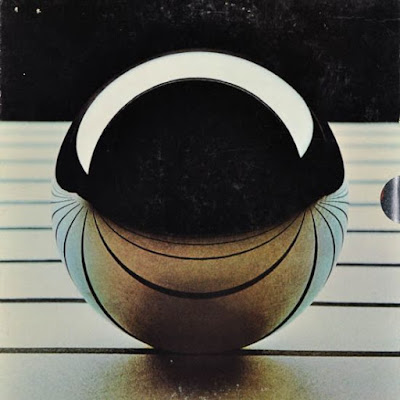
I’ve been listening to The Who these past few days (in between bouts of Herbie Hancock’s Headhunters LP and the 1st African Head Charge album), and leafing thru a Who magazine I stumbled across the 1972 curio Tommy Performed by the London Symphony Orchestra & Chamber Choir. This particular Tommy doesn’t hold much interest for me (I’m listening to some samples now on youtube and it’s rather corny), but the Tom Wilkes’ album design is truly fantastic – the smooth metallic, reflective surface of the pinball feels incredibly sensual. I used to see the album in second-hand records stores throughout the 90’s, the LP box almost always falling asunder and missing the inserts. If I was a bigger Who fan, I would seek out a copy for Wilkes’ design work alone, but Discogs scratches that particular itch with some nice scans of the inner contents. The idea of the all-seeing pinball popping up in various locations has me racking my brains to where I’ve seen this motif before – perhaps I’m thinking of the strange phallic ornament that appears in the photographs on Zep’s Presence album, or the megaphone seen in various locations on Depeche Mode’s Music for the Masses. I like Wilkes’ cover enough to think it superior to the Dark Side of the Moon’s prism, and casting commercial concerns aside, it would have made a terrific Phantasm poster…

Friday, 7 April 2017
Favourite Hong Kong Films
The Big Boss is probably no one's favourite Hong Kong film but it was the first Hong Kong film I saw and was my passport into a strange new world of Asian Cinema, of flying fists, righteous revenge and dubbing that left characters mouths flapping like stranded fish. It's primitive, even by later Bruce Lee vehicles, and the plot of the film holds Lee back from fighting for over an hour, making it all the more sweeter when the Little Dragon uncoils into a weapon of mass destruction...

If The Big Boss was a personal first, then so too was Hardboiled, John Woo's 1991 film, my first introduction to the so-called "Heroic Bloodshed" genre. Woo may have made better films but in many ways Hardboiled is the director's slickest, most streamlined film and not surprisingly Hardboiled was instrumental in introducing the West to Hong Kong's revolutionary gun operas, the dazzling choreography, death before dishonor, and ammo clips that never run dry...

Stylish, intelligent and complex enough to demand multiple viewings, Mad Detective, Johnny To and Wai Ka-Fai's 2007 film, the newest arrival on my list has in it's short life become an instant classic. For the few reading this who haven’t yet seen the film, it's best to go in knowing as little as possible - The Sixth Sense and Fight Club toyed with a similar plot device but Mad Detective avoids the join-the-dots approach to story-telling and makes its audience do its own detective work but once you surrender yourself to the film's hallucinatory weirdness you'll begin to wonder why all films aren't made like this...

A Hong Kong film about two gay men living in Argentina is notable for that alone, but Happy Together, Wong Kar-Wai's 1996 film, a mockingly-titled meditation on the impossibility of relationships is one of the great masterpieces of World Cinema. Impossibly stylish, and shot with an arsenal of different film stocks and lighting and improv-style cutting the film drew comparisons with Jean-Luc Godard's most vital work, but Happy Together is more like a piece of free jazz - joyous, spontaneous, inventive, hypnotic, and mesmerizing...

Legendary for popularizing Martial Arts films in America (only previously seen in a few isolated Chinatown districts), Five Fingers of Death is likely to topple under the weight of history, but Chang-Hwa Jeong's film still remains a touchstone of the genre. Aside from the thrill of the action set-pieces, the story is dramatically satisfying, the performances, at least in the Mandarin version have depth and weight, and in contrast to the exquisite Shaw Brothers sets and photography the violence is surprisingly grisly. Seminal stuff...

Dangerous Encounter - 1st Kind is a hand grenade of a film, set in a decidedly grimy and unglamorous Hong Kong rife with overcrowding, vicious triad gangsters and teenagers who get their kicks from urban guerrilla warfare and torturing small animals. I first saw the film in 2011 and was so utterly astonished I wrote "So volatile a mix, the celluloid itself seems in danger of catching fire as it runs through the projector gate". If this very unique film has a spiritual heir it might well be Takashi Miike's unhinged City of Lost Souls and his Dead or Alive films, and appropriately enough Tsui Hark's great outlaw film includes illicit snatches of Goblin's Dawn of the Dead score and Jean-Michel Jarre's Oxygène (?)

John Woo's 1990 film Bullet In the Head doesn't have the tight framework of The Killer or Hardboiled, it's story of three lifelong friends trying to make their fortune is altogether more expansive moving out of the turbulent streets of Hong Kong and into the maelstrom of the Vietnam War. The film is nothing less than an epic, and Woo shows tremendous style and maturity in his approach to the material. Unlike the balletic action of his gangster films, the violence in Bullet In the Head is ugly and harrowing, so much so the British Censor was once reluctant to give the film a certificate. A John Woo film to savor, if only because Bullet In the Head is one of his last great films before a regrettable move to Hollywood and the string of mediocre American films that followed...

Quite possibly the sexiest PG-rated film you are ever likely to see, In the Mood For Love, Wong Kar-Wai's millennium follow-up to Happy Together is a far more delicate affair, with career best performances from Maggie Cheung and Tony Leung. No surprise that it's ended up in many people's lists, the film is a cinematic tour de force of direction, editing, costumes, music (Yumeji's Theme once heard is never forgotten), Christopher Doyle's extraordinarily sensual photography and that wonderful strange and dreamlike ending among the ruins of Angkor Wat...

If The Big Boss was a personal first, then so too was Hardboiled, John Woo's 1991 film, my first introduction to the so-called "Heroic Bloodshed" genre. Woo may have made better films but in many ways Hardboiled is the director's slickest, most streamlined film and not surprisingly Hardboiled was instrumental in introducing the West to Hong Kong's revolutionary gun operas, the dazzling choreography, death before dishonor, and ammo clips that never run dry...
Stylish, intelligent and complex enough to demand multiple viewings, Mad Detective, Johnny To and Wai Ka-Fai's 2007 film, the newest arrival on my list has in it's short life become an instant classic. For the few reading this who haven’t yet seen the film, it's best to go in knowing as little as possible - The Sixth Sense and Fight Club toyed with a similar plot device but Mad Detective avoids the join-the-dots approach to story-telling and makes its audience do its own detective work but once you surrender yourself to the film's hallucinatory weirdness you'll begin to wonder why all films aren't made like this...
A Hong Kong film about two gay men living in Argentina is notable for that alone, but Happy Together, Wong Kar-Wai's 1996 film, a mockingly-titled meditation on the impossibility of relationships is one of the great masterpieces of World Cinema. Impossibly stylish, and shot with an arsenal of different film stocks and lighting and improv-style cutting the film drew comparisons with Jean-Luc Godard's most vital work, but Happy Together is more like a piece of free jazz - joyous, spontaneous, inventive, hypnotic, and mesmerizing...
Legendary for popularizing Martial Arts films in America (only previously seen in a few isolated Chinatown districts), Five Fingers of Death is likely to topple under the weight of history, but Chang-Hwa Jeong's film still remains a touchstone of the genre. Aside from the thrill of the action set-pieces, the story is dramatically satisfying, the performances, at least in the Mandarin version have depth and weight, and in contrast to the exquisite Shaw Brothers sets and photography the violence is surprisingly grisly. Seminal stuff...
Dangerous Encounter - 1st Kind is a hand grenade of a film, set in a decidedly grimy and unglamorous Hong Kong rife with overcrowding, vicious triad gangsters and teenagers who get their kicks from urban guerrilla warfare and torturing small animals. I first saw the film in 2011 and was so utterly astonished I wrote "So volatile a mix, the celluloid itself seems in danger of catching fire as it runs through the projector gate". If this very unique film has a spiritual heir it might well be Takashi Miike's unhinged City of Lost Souls and his Dead or Alive films, and appropriately enough Tsui Hark's great outlaw film includes illicit snatches of Goblin's Dawn of the Dead score and Jean-Michel Jarre's Oxygène (?)
John Woo's 1990 film Bullet In the Head doesn't have the tight framework of The Killer or Hardboiled, it's story of three lifelong friends trying to make their fortune is altogether more expansive moving out of the turbulent streets of Hong Kong and into the maelstrom of the Vietnam War. The film is nothing less than an epic, and Woo shows tremendous style and maturity in his approach to the material. Unlike the balletic action of his gangster films, the violence in Bullet In the Head is ugly and harrowing, so much so the British Censor was once reluctant to give the film a certificate. A John Woo film to savor, if only because Bullet In the Head is one of his last great films before a regrettable move to Hollywood and the string of mediocre American films that followed...
Quite possibly the sexiest PG-rated film you are ever likely to see, In the Mood For Love, Wong Kar-Wai's millennium follow-up to Happy Together is a far more delicate affair, with career best performances from Maggie Cheung and Tony Leung. No surprise that it's ended up in many people's lists, the film is a cinematic tour de force of direction, editing, costumes, music (Yumeji's Theme once heard is never forgotten), Christopher Doyle's extraordinarily sensual photography and that wonderful strange and dreamlike ending among the ruins of Angkor Wat...
Sunday, 26 March 2017
Throbbing Gristle - Brighton Polytechnic, March 26th 1977
Throbbing Gristle's show at the Brighton Polytechnic (the first of two visits by the group, a second followed in 1978), was staged at the campus' Sallis Benney Theatre, a dingy cavernous space that served as a locus for all sorts of idiosyncratic art happenings. Invited by the students from the art and design faculty, the group might have expected a more receptive audience than the sneering punks at the previous show at the Nag's Head in High Wycombe, but TG managed 50min of their 1-hour set before a hail of jeers and bottles flung by drunk, abusive punters brought things to a close. As TG concerts go, the Brighton '77 show is one of the group's finest, and despite the antagonism on the night, the group were pleased enough to include a few excerpts from the show on Second Annual Report. The Brighton show opens with a particularly strong Zyklon B Zombie, and it's curious that TG all but retired the song after the concert, dropped from the set-list, with the studio version only making a belated appearance a year later as the flipside of the United single. Ominous bass rumblings, eerie drones and garbled walkie-talkie sounds usher in the urban paranoia of Last Exit, (the title, one presumes, a nod to the Hubert Selby Jr. novel), which builds to a chugging mechanical crunch accompanied by a surreal Genesis P-Orridge vocal about being smashed in the face with a brick and suffering disturbing visions of the British Queen being sodomized by her husband. The lengthy instrumental passage that follows is one of the great TG jams, an astonishing free form torrent of noise and mangled voice sample cut-ups, including the dispassionate confession of a teenage murderer, surely one of Sleazy's most effective dialogue lifts. Genesis returns to the mike for Mary Jane / Record Contract with an improvised vocal that is silly, witty, embarrassing, and ultimately fascinating, the long rambling monologue that eventually mutates into a rant against rock star posturing and record company prostitution, the Sex Pistols in particular the focus of Genesis' scorn. Despite the Pistols burning through contracts with EMI and A&M, (and pocketing the severance pay), Genesis clearly valued TG's independence over Malcolm McLaren's cash from chaos strategies.

Perhaps the biggest talking point of the Brighton '77 show (or the concert recording at least) is the coda tacked on to the end of the Industrial tape where the house DJ berates the audience for their hostility towards TG, sarcastically blasting out The Stooges' Down on the Street on the PA. The group, ever mischievous included a few seconds of the exchange to close out one side of Second Annual Report, (a companion of sorts to D.o.A.'s Death Threats) and it's worth noting that this short snippet is the only place where one can hear (albeit a few seconds only) of the Funhouse opener; the Stooges airbrushed entirely from the TG24 CD edition of the Brighton show. And while the concert never descends into the violence of the Film Makers Co-Op show, the mood sounds edgy and tense - at one point Genesis can be heard saying "make sure everything is safe" presumably referring to TG's equipment. In the years following TG's split individual members would recall weariness at the increasing adulation they were seeing at later shows, a sharp contrast to the sense of disillusionment at the Brighton performance. No breakthrough in grey room it seems...

Perhaps the biggest talking point of the Brighton '77 show (or the concert recording at least) is the coda tacked on to the end of the Industrial tape where the house DJ berates the audience for their hostility towards TG, sarcastically blasting out The Stooges' Down on the Street on the PA. The group, ever mischievous included a few seconds of the exchange to close out one side of Second Annual Report, (a companion of sorts to D.o.A.'s Death Threats) and it's worth noting that this short snippet is the only place where one can hear (albeit a few seconds only) of the Funhouse opener; the Stooges airbrushed entirely from the TG24 CD edition of the Brighton show. And while the concert never descends into the violence of the Film Makers Co-Op show, the mood sounds edgy and tense - at one point Genesis can be heard saying "make sure everything is safe" presumably referring to TG's equipment. In the years following TG's split individual members would recall weariness at the increasing adulation they were seeing at later shows, a sharp contrast to the sense of disillusionment at the Brighton performance. No breakthrough in grey room it seems...
Wednesday, 22 March 2017
Bruegel snow
It’s snowing in this part of the world this morning, something of a rarity these days with Ireland’s Goldilocks weather (not too hot, not too cold). And gazing out the office window at the white-coated rooftops, I’m reminded of Pieter Bruegel the Elder’s 1565 painting The Hunters in the Snow; that vague sense of dissatisfaction that hovers over me this morning (I could be home watching the snow-bound Day of the Outlaw, or The Thing, or gosh, Quintet !) shared by the weary, empty handed hunters in Bruegel’s painting, trudging back to their village after an unsuccessful hunt. Still, looking at The Hunters in the Snow, my thoughts happily turn to Solaris, which introduced me to this great work, the painting hangs in one of the rooms of the Prometheus space station. In those days before Wikipedia’s huge high res scans, Tarkovsky very helpfully panned his camera across the painting to reveal some of those incredible details – I especially like the activity on the frozen lake, the three children skating in formation, or one less skillful villager lying in a heap. As ever, the Wiki page is well worth a visit, or why not give Tarkovsky’s film another watch…

Tuesday, 21 March 2017
Film Quarterly Graphics
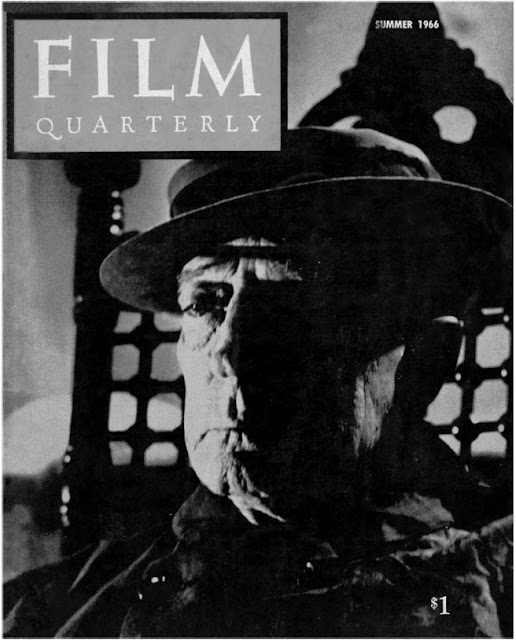
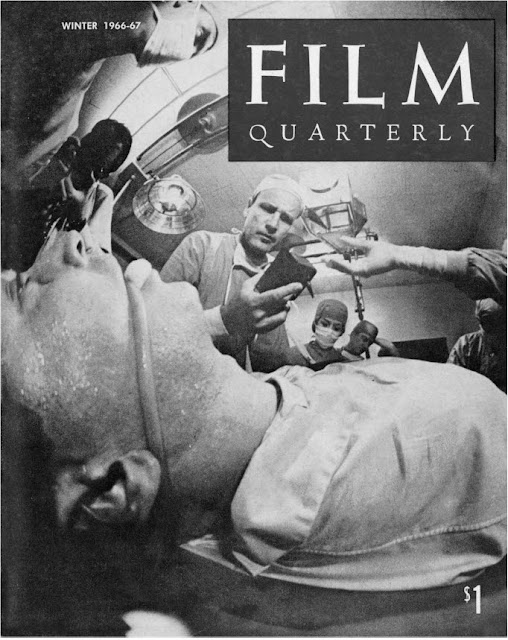
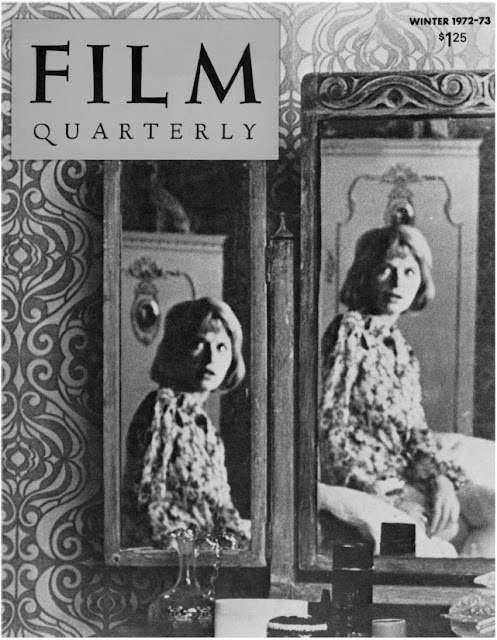
An old external hard drive I had stashed away in a drawer yielded some unexpected treasure last night in the shape of 256 scanned pdf issues of Film Quarterly magazine, spanning the years 1946 to 2011. I downloaded these from a share site many years ago and promptly forgot about them, but I’ve been skimming thru some issues this morning and I must devise a reading plan. I’ve been gravitating towards the older issues, the 70’s especially, and it’s always nice to read a contemporary review of a film without the weight of cultural baggage – in the Summer 1976 issue Michael Dempsey takes Taxi Driver to task for its “slippery plotting” and Dempsey’s legitimate compliant that Travis Bickle’s bizarrely misjudged date with Betsy at the porno cinema (or “stroke house” as Dempsey calls it) was simply a way for Paul Schrader to elbow her character out of the picture to make way for the violent finale... For this post I’ve snagged a selection of Film Quarterly covers (sadly the entire archive is in b/w) but it gives a good sense of the journal’s scope…



Browsing thru the older issues, it’s nice to come across ads for film rentals – fascinating to see what was available to the film connoisseur in the pre-VHS days. I especially like this striking advert for a quartet of John Cassavetes films, found in the Autumn 1976 issue...
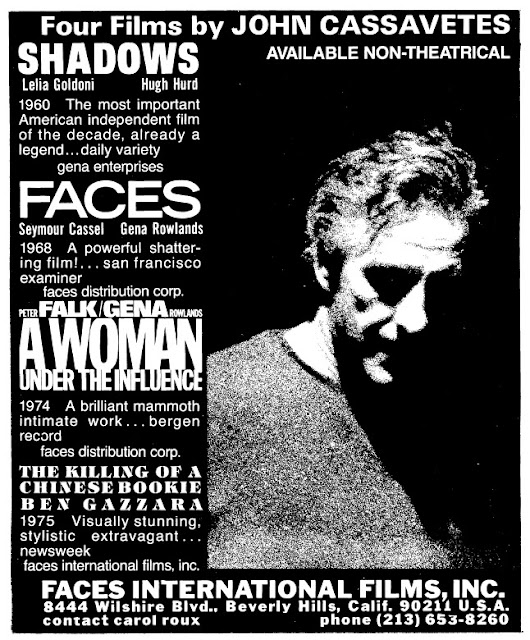


Browsing thru the older issues, it’s nice to come across ads for film rentals – fascinating to see what was available to the film connoisseur in the pre-VHS days. I especially like this striking advert for a quartet of John Cassavetes films, found in the Autumn 1976 issue...

Wednesday, 15 March 2017
Tuning in to the early Beatles
I read somewhere last week that Mark Lewisohn’s second volume of Beatles history will be with us later this year and it was enough to motivate me last night to finally start Tune In which covers the Liverpool and Hamburg years. I usually find the biography’s genealogical preamble a chore to get thru but it’s good to be reminded that 3 of 4 Beatles had Irish roots and Lewisohn is particularly engaging on Liverpool, evocatively painting a picture of a grimy, polluted city that took a beating from the German Luftwaffe but remained resilient throughout. A tough town to grow up in which no doubt stood the Beatles in good stead for their hard-working days and nights on the Hamburg club circuit. This first volume doesn’t cover much recorded Beatles music, chronologically speaking – the debut single, and early sessions for the Please Please Me album, so I’m dipping into the Tony Sheridan recordings, the December 1962 Star Club show and a collection of tracks over on youtube called the “Home Recordings, July 1960”. I’m usually weary of these things when they don’t come annotated - the recording date suggests the tracks are also known elsewhere as the Forthlin Road Tapes but the youtube tracklist differs somewhat – but my leap of faith is at least paying off with some terrific embryonic rock n ’roll, the ultra lo-fi recording quality lend the guitars a real muscular shronk!, and some of the extended bluesy jams (audible fluffs and all) sound fabulous to these ears… Incidentally, I had a dream last night that my 16-month daughter was climbing up a ladder (she’s in a climbing phase at the moment) and it reminded me of John Lennon’s famous first meeting with Yoko Ono at the Indica Bookshop in November ‘66, where Lennon climbed up a ladder that was part of one of Yoko’s installation pieces – a happy bit of serendipity to kick off the book I think.

Tuesday, 14 March 2017
Banzai! Japanese Cult Movie Posters
Some Japanese posters for your viewing pleasure… Banzai! Japanese Cult Movie Posters, the latest book by Creepy Images, purveyors of rare posters and memorabilia from the halcyon days of Psychotronic Cinema, arrived on my doorstep just before Christmas and what with our big trip to Vietnam in January, I haven’t had much chance to pour over the contents. Fortunately, I found some time at the weekend to take a leisurely browse through the full color, high-quality 296 glossy pages, and managed to grab a few shots just to give you a taste of this deliriously head-spinning collection. The posters are arranged within 5 broad chapters - Bad Girls, Tough Guys, Horror, Mondo, Shocking and Science-Fiction & Fantasy, and include Pinky Violence, Yakuza films, Italian Westerns, Hammer Horror, American Exploitation, European Splatter, eye-watering Shockumentaries, Kaiju jamborees and special effects extravaganzas...
From Bad Girls... (Click on the images for larger resolution)


From Horror...


From Shocking...


Japanese poster design is renowned for the riot of photo-montage imagery and large typefaces that yell at punters for attention, but occasionally a designer will swim against the tide of tradition and produce something like the superb poster for Henry: Portrait of a Serial Killer, where the titular character appears pressed into what looks like a tombstone. A very strange motif, and were it not for the Japanese calligraphy, I might have thought this was a poster from Eastern Europe.

Japanese posters for The Texas Chain Saw Massacre are not especially rare, they’ve been reprinted many times, but this poster featuring the agonized death throes of Teri McMinn captures best the sheer feverish intensity of the film, the over-saturated red in the design makes the onlooker decidedly queasy…

And finally, from the sublime to the horrid, the poster for The Dead Zone, featuring a most unflattering shot of Christopher Walken’s character Johnny Smith in a coma. “What happened?” indeed…

From Bad Girls... (Click on the images for larger resolution)


From Tough Guys...


From Horror...


From Mondo...


From Science-Fiction & Fantasy...

Japanese poster design is renowned for the riot of photo-montage imagery and large typefaces that yell at punters for attention, but occasionally a designer will swim against the tide of tradition and produce something like the superb poster for Henry: Portrait of a Serial Killer, where the titular character appears pressed into what looks like a tombstone. A very strange motif, and were it not for the Japanese calligraphy, I might have thought this was a poster from Eastern Europe.


And finally, from the sublime to the horrid, the poster for The Dead Zone, featuring a most unflattering shot of Christopher Walken’s character Johnny Smith in a coma. “What happened?” indeed…

Friday, 10 March 2017
Art Thing
Bill Sienkiewic’s haunting artwork based on John Carpenter’s classic The Thing… Some interesting Thing stuff coming our way this year. Arrow is set to put out what will most likely be the definitive Blu-Ray edition of the film later this year, and to tide us over July sees the release of The Thing Artbook, a 400 page hardback compendium of artwork inspired by the film. More details here... Let’s hope the book’s publishers Printed In Blood will get a few copies over to Europe for sale.

All this reminds me of John Higgins' spectacularly gruesome artwork for Dark Horse's 1992 double-header comic sequel which picks up from where the film leaves off for one more battle between MacReady and the alien. I wish I had my two issues at hand right now because Higgins' story artwork is very beautiful. Given the shape-shifting antics of the alien, The Thing is one of those rare gifts that invites artists to let their imagination run riot. I have high hopes for The Thing Artbook...


All this reminds me of John Higgins' spectacularly gruesome artwork for Dark Horse's 1992 double-header comic sequel which picks up from where the film leaves off for one more battle between MacReady and the alien. I wish I had my two issues at hand right now because Higgins' story artwork is very beautiful. Given the shape-shifting antics of the alien, The Thing is one of those rare gifts that invites artists to let their imagination run riot. I have high hopes for The Thing Artbook...


Subscribe to:
Posts (Atom)